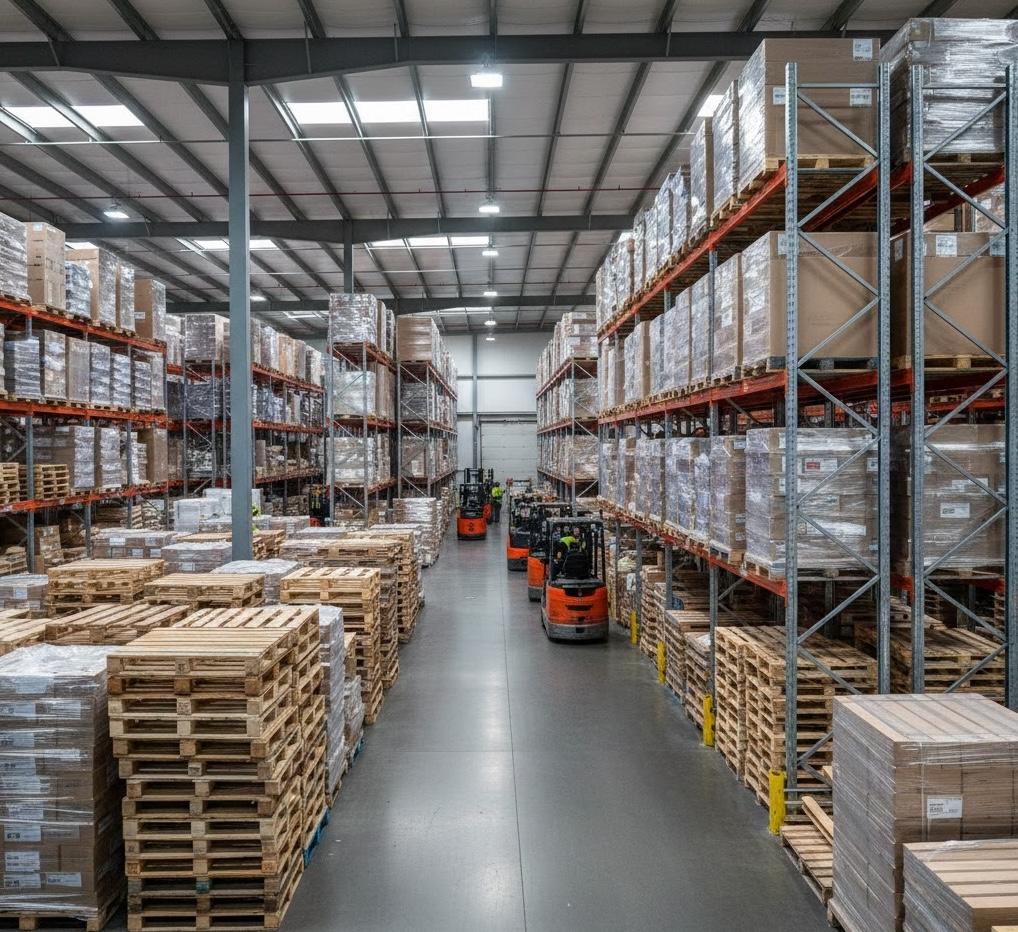
A third-party logistics company is an external provider that manages some or all of your supply chain services, including warehousing, inventory management, order fulfillment, packaging, shipping, and returns. Rather than renting out your own facility and employing your own team, you integrate into another person’s infrastructure, processes, and carrier network, paying for services rendered.
The third-party logistics market size in the United States, according to Armstrong & Associates, reached $323.4 billion in 2025, representing 5.0% year-over-year growth, so it has definitely passed the trial phase by now.
Our company, Bee Imagine, works in that sphere and provides fulfillment and Foreign Trade Zone warehousing services out of our four Southern California fulfillment centers.
Having said that, outsourcing is not always the best way forward, and many companies enter into agreements without being ready for it. So, here is how to tell whether it fits your operation, and when it clearly does not.
The label covers a lot of ground. There are some companies that do freight brokerage without getting anywhere near your inventory, while others own the warehousing facility and take complete control of your products. When you opt for third-party logistics services, chances are you will get a package deal of services.
Storage, cycle counting, lot and batch tracking, and a system that reports what you own in real time. Space can be standard, bonded, or Foreign Trade Zone designated, and that designation changes how duties get handled.
Picking, packing, labeling, gift sets, subscription boxes, and returns processing. For direct-to-consumer brands, this sits at the heart of the relationship, since every late or wrong shipment lands on your reviews instead of theirs.
Shipping containers off the port, securing truckload or less-than-truckload capacity, and coordinating parcel carriers. Drayage and parcel are different skills from warehousing, which is why there are few firms capable of doing everything well.
There are two key reasons for this. According to the 2024 State of Logistics Report from the Council of Supply Chain Management Professionals, the U.S. business logistics costs increased by 5.4 percent in 2024 to $2.58 trillion or 8.8 percent of the gross domestic product.
The goods are still being imported into West Coast ports. In 2024 alone, the Port of Long Beach saw a record number of 9.6 million cargo containers, and each of these cargo containers had to have a receiver, yard, and a truck.
It is safe to say that most brands are not implementing 3PL solutions because they are excited about it. They are simply slower to build this solution within their organization.
There is no universal trigger, but a few patterns show up repeatedly in operations that outsource successfully. If any of these sound familiar, the warehouse is probably not the best use of your team's time.
Knowing when not to outsource matters just as much. If volume is steady, products are simple, and you genuinely like running the floor, adding a provider introduces a layer you may not want.
Every provider claims technology, accuracy, and speed. The sales deck will not show you how the relationship feels in month eight, so verify these points yourself before signing anything long-term.
Ready to see how a live operation runs?
Bee Imagine is a California-based 3PL provider built for importers and direct-to-consumer brands that want freight handled close to where it lands, not three time zones away from the port.
We pair Foreign Trade Zone warehousing with daily fulfillment work instead of treating customs and shipping as unrelated services, which matters when a container, a duty decision, and an online order converge on the same day.
Here’s why we are a top 3PL choice:
Not sure if your volume justifies outsourcing?
Talk to a Logistics Specialist
Do not outsource just because the competition did so. It makes sense to do it only if your order flow, product complexity or imports have grown past the capabilities of your in-house staff.
As far as the importers of Southern California are concerned, 3PL fulfillment services, which include drayage, FTZ warehousing, and direct-to-consumer delivery, minimize friction to the largest extent possible. Evaluate it.
Bee Imagine integrates Foreign Trade Zone warehousing, Port of Long Beach drayage, and consumer delivery services into one, so your shipping container, inventory, and order management will all be handled by the same team. A standard public warehouse holds your inventory and leaves trucking, customs clearance, and packaging in your hands.
The former uses its own or leased warehouse space and transportation equipment. The latter does not have any and coordinates several logistics suppliers on your behalf. Brands usually begin with 3PL service and think about 4PL later, when dealing with several providers already.
Fulfillment shift takes several weeks rather than days, especially if there are multiple sales channels and customs duties involved. The most important factor in fulfillment transfer is inventory accuracy at the outgoing warehouse because every mistake should be fixed before the first order goes out.
Yes, and returns often drive the switch. U.S. retailers saw an estimated $890 billion in returns in 2024, or 16.9% of annual sales, according to the National Retail Federation. A capable provider inspects, restocks, refurbishes, or disposes of that inventory rather than letting it pile up.
Only if you allow it; most providers build your packaging specification into standard operating procedures with photo documentation and quality checks. Review the work instructions before launch, then sample incoming orders during the first month to confirm the spec holds.