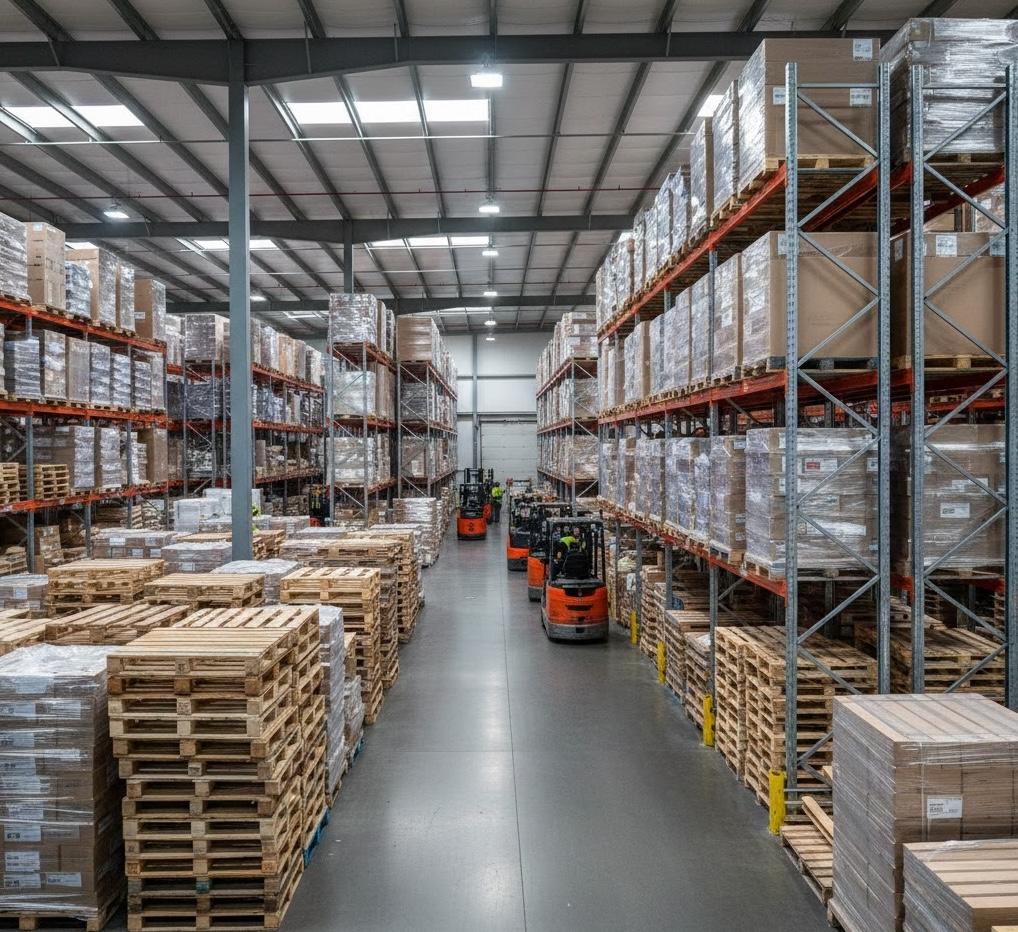
An in-house warehouse works when volume is stable, products are simple, and you want control over every pick station. A third-party logistics company fits better when demand swings hard, capital is limited, or recruiting eats your week.
Bee Imagine provides 3PL fulfillment services in California from four facilities, and we have watched brands move both directions. Some outgrow their building in one peak season, while others pull work back once volume settles.
Neither model wins on principle. The decision hinges on how variable your order volume is, how much fixed commitment you can stomach, and whether logistics expertise already exists on your team. Here is how we walk clients through it.
The pitch rarely mentions the operational detail. Start with three factors you will feel within ninety days, because they decide whether the model fits or fights your business.
You keep your own supervisors and procedures, so a problem gets fixed the same hour it appears. With an outside provider, you trade that immediacy for documented processes and reporting you can audit instead of assume.
A lease locks you into a building for years whether or not volume shows up. CBRE reported Inland Empire industrial vacancy at 7.4% in Q2 2026, with the under-construction pipeline 41.3% below year-ago levels.
BLS figures put warehousing and storage employment near 1.84 million as of August 2026 with a total recordable injury rate of 4.8 per 100 workers in 2024. Staffing up and down around that risk is seasonal work.
CTA:
Still deciding between building and outsourcing?
Request a Fulfillment Assessment
Both models carry real downsides, and the honest ones rarely make the slide deck. Before you commit to 3PL fulfillment services in California or anywhere else, pressure-test how a provider handles a bad month.
You lose elasticity. A fulfillment center sized for 5,000 daily orders cannot absorb 20,000 without overtime, contract labor, and errors. Safety, hiring, and compliance obligations also stay on your books.
Your products reside in another person’s facility, and your visibility is contingent upon their reporting system. In fact, according to the Annual Third-Party Logistics Study, only 55% of shipper-provider relationships are classified as strategic alliances.
Plenty of mid-market brands run both. They keep a small operation for fast-moving SKUs and route returns, imports, or overflow to a partner offering e-commerce fulfillment services. It works, but only with clean inventory rules.
Answer these honestly, and the choice usually makes itself. Line up the 3PL fulfillment benefits against what you surrender in control, and if your answers split, outsourcing is the safer starting point.
Three or more of these pointing the same direction is usually enough signal to start provider conversations. Below that, keep the warehouse in-house and revisit the question after your next peak season.
We are not neutral on this question. Bee Imagine is a California 3PL fulfillment business built by people who spent years inside import-heavy supply chains, and that history shapes what we offer.
Our 3PL fulfillment services in California are built for importers who want bonded storage and daily shipping managed by one team, rather than two vendors pointing at each other when something goes wrong.
CTA:
Want to see our California facilities in person?
Schedule a Warehouse Tour with Bee Imagine
The decision is not permanent. Brands go in-house when volumes get stable and processes predictable, and switch out when a new channel or importing takes on more volume than four walls can hold. Think of it as one stop along the way.
If you are comparing the use of e-commerce fulfillment services against going it on your own, take into account three key figures: your range of volume peaks and troughs, your bonded inventory levels, and your lost work hours because of logistics.